The newest letterpress card in our Change the World card series has arrived! Fin is a new letterpress card whose proceeds will help the Monterey Bay Aquarium Seafood Watch®, a program that engages and empowers consumers and businesses to purchase seafood that is fished or farmed in ways that minimize their impact on the environment.

Why should you care about where your seafood comes from?
- 90% of table fish (including cod, shark, swordfish, salmon, and more) have been fished out of the oceans. Many fish and other animals caught in fishing gear are thrown away as unwanted bycatch – amounting to many millions of metric tons of marine life wasted each year. Scientists predict that if we continue on this path, we’ll see the end of most seafood by 2048.
- Fish are important. They contribute to healthy oceans and act as an essential source of protein for many cultures. The global consumption of fish has hit a record high, reaching an average of 17kg per person. Fisheries and aquaculture supplied the world with about 145m tonnes of seafood in 2009, providing about 16% of the population’s animal protein intake. As such, the loss of seafood as a viable food option could lead to mass starvation.
- Healthy, wild ocean ecosystems provide a variety of other services to the planet, including the air we breathe. Scientists believe that phytoplankton, tiny ocean plants, contribute between 50 to 85 percent of the oxygen in Earth’s atmosphere.
What can you do about it?
- The most important thing you can do is to vote with your fork. Carry your Seafood Watch® pocket guide (or get the app on your smartphone!) and use it to purchase sustainable seafood wherever you go. Use the guide to find your “Best Choices” or when those aren’t available, “Good Alternatives”. (Our Fin cards come with a Seafood Watch® pocket guide!)
- Help raise awareness by sharing information with friends and family. You can also ask questions about where they purchase seafood. Businesses respond to the needs of their paying customers – so the importance of this action cannot be overestimated.
- Visit the Monterey Bay Aquarium Seafood Watch® online to learn more about what you can do to make a difference.

We recently had the pleasure of working with the Northeast Organic Farming Association of New York on a letterpress invitation set for their 2012 Fall Benefit. We provided pro bono letterpress printing for the invitations, which feature our new Tatra design in azure and orchid inks. This year’s NOFA-NY benefit was held at Back Forty in New York City, and honored Frances Moore Lappé (an accomplished author and cofounder of Food First: The Institute for Food and Development Policy and the Small Planet Institute), as well as Benjamin Shute and Lindsey Lusher Shute (owners of Hearty Roots Farm, a diversified vegetable farm and farm share program. Lindsey is also the Director of the National Young Farmers’ Coalition (NYFC)). Many thanks to NOFA-NY for giving us the opportunity to participate in such a special event!

We’re proud to introduce our new Sunflower calendars as the latest installment in our Change the World letterpress series! These limited edition 8×10 art print calendars are letterpress printed on our ultra thick 2-ply bamboo paper and are on sale for $10 each, and 100% of profits from the calendars will be donated to the Pesticide Action Network (PAN). The calendars celebrate the nonprofit’s 30th anniversary and proceeds will help PAN in their efforts to replace the use of hazardous pesticides with ecologically sound and socially just alternatives. Happy birthday, PAN!

Want to learn more about PAN and ways you can help their mission? Check out this blog post about our Sunflower cards or visit panna.org.
If you haven’t purchased a box of letterpress Change the World cards yet (or if you’re looking to buy more!), you’re in luck. From now through August 27, get an extra 25% off all sale items when you buy a box of our Change the World cards. Use discount code zaeg6Dub at checkout to take advantage of this offer.

Our Change the World letterpress card series launched earlier this year (100% of profits are donated to critical environmental causes) and we can’t say enough good things about the organizations these cards help. Profits from the first card in the series, Sunflower, are donated to the Pesticide Action Network North America to address Colony Collapse Disorder and help save the honey bees (our food supply is dependent on them!). The cards come with organic sunflower seeds that you can plant to help the bees out!

The profits from the series’ second card, Fracking, helps Earthworks’ Oil & Gas Accountability Project change the gas and oil industry in order to protect the environment and our drinking water. The Fracking cards come with temporary tattoos — you can view photos of people wearing their tattoos (and upload a photo of your own!) on the special Tumblr page we’ve set up at gas-and-water-dont-mix.Tumblr.com.

The fine print: sale ends at 11:59pm on Monday, August 27. Order must contain a minimum of 1 box of Fracking or Sunflower cards to receive the discount.
We’re so excited to introduce our newest card in the “Change the World” letterpress card series, where we donate 100% of profits to a critical environmental issue. The second card in our series is called Fracking, and will benefit Earthworks. The cards also come with an anti-fracking tattoo!


Here’s the problem: In the U.S., we’re drilling around 2,000 new oil and gas wells per month. 90% of these new wells use a process called “hydraulic fracturing”, also known as fracking. To get the natural gas out of the ground, fracking requires 3-15 million gallons of water plus a lot of chemicals. Rarely do we know what these chemicals are; the oil and gas industry is exempt from the Safe Drinking Water Act, the Clean Water Act, the Clean Air Act, and the Superfund law. A large percentage of this chemical laced water remains in the crevices of the earth, soaking into the ground, and threatening our clean water supply.

Is there a realistic solution? Fracking is scary, but it’s only part of the problem – change needs to happen. Earthworks’ Oil & Gas Accountability Project is working to reform the entire oil and gas industry. Earthworks believes that corporations should be allowed to extract and process mineral fuels only if they can do so without harming human health or contaminating the air, water, and soil, with an eye on impacts at all levels: local, regional, and global. This means achieving the following goals:
- No water pollution: protect public health, the environment, and the climate from toxic, hazardous, and carcinogenic chemicals used in the extraction of fossil fuel energy resources;
- Low emissions: protect public health, the environment, and the climate from pollutants emitted during the drilling and ongoing production of energy resources;
- No-Go Zones: protect sacred areas, fragile ecosystems, neighborhoods, drinking watersheds and densely populated areas targeted for energy development;
- Landowner or Community Consent: continue to develop and then implement laws and policies ensuring that landowners have essential co-equal rights to negotiate with, and to say ‘no’ to, energy development.
Take action now:
- Contact your legislators and ask them to protect our clean air and clean water from fracking by supporting the FRAC Act. The FRAC Act would close the “Halliburton loophole” in the Safe Drinking Water Act that allows drillers to inject hazardous materials — unchecked — directly into underground drinking water supplies.
- Get informed: learn more at Earthworks.
- Make a contribution: help Earthworks continue the good fight by making a donation. If you follow this link, you can get your very own “Gas and Water Don’t Mix” temporary tattoos (created & designed by Smock!) when you make a contribution to Earthworks (while supplies last).
- Join the conversation on our tumblr blog: In collaboration with Earthworks, we’ve created a tumblr blog called Gas and Water Don’t Mix (gas-and-water-dont-mix.tumblr.com), a place where those who care about fracking can build a communal voice around the issue. Concerned citizens can go on and add a photo of themselves in a place they love, and include a few sentences about why they are freaked out by fracking. We’re encouraging everyone to don the Gas and Water Don’t Mix temporary tattoo in solidarity of the issue on the blog.
We’re thrilled to introduce our new “change the world” letterpress card series, where we’ll donate 100% of profits to a critical environmental issue. The first card in our series is called Sunflower, and will benefit the Pesticide Action Network North America (PANNA).
Here’s the problem: Honey bees are in trouble — colonies have been collapsing mysteriously and adult bees are disappearing. The problem started in the mid 2000’s and is known as “Colony Collapse Disorder,” and researchers believe that pesticides, habitat loss, pathogens and immune system damage are factors that may be causing the collapse.
Why you should care: Of the 100 crops that provide 90% of the world’s food supply, over 70 of those crops are pollinated by bees. In the United States alone, the bees’ contribution is valued at over $15 billion, and this vital industry is on the verge of collapse. One out of every three bites of food are dependent on honey bees for pollination, so government action is critical to help the colonies recover.
Take action now:
- Sign this petition to help protect the bees. By doing so, you will encourage the U.S. Environmental Protection Agency (EPA) to enforce restrictions (such as not spraying while pollinator-dependent crops are in bloom) and to take action against pesticides that are toxic to the honey bees.
- Get informed: learn more at PANNA.
- Start your own bee-friendly garden: Grow plants (like sunflowers!) to help the bees out. Download this handy brochure from PANNA for some bee-friendly gardening tips.
- Make a contribution: help PANNA continue their program work by making a direct contribution, or purchase our sustainably printed Sunflower cards — 100% of profits will be donated to PANNA to help save the honeybees, and organic, locally grown sunflower seeds are included with the cards for you to plant.

What books have changed your life? What have you read that’s really stuck with you over time? We love a captivating read as much as we love letterpress around here, and while we know it can be hard to find the time to sit down and soak up a good book, we believe it’s important to make the time. So every now & then we’d like to share with you some of the books that have impacted us, and we’d love to know your thoughts – feel free to discuss with us in the comments section below! First up, Debbie Urbanski shares her thoughts on Half the Sky.
Hi. I’m Debbie, one of the co-owners of Smock. That’s my day job at least, though I went to school for writing, and one of the things I’ve been missing lately about my grad school days is discussions about books. Not just discussions such as, “Man, I don’t have any time to read anymore,” or, “I read this article on the New York Times website,” but discussions about books we actually read and loved, or didn’t love. Though the best discussions were about the books that not only we loved but books that changed us, sometimes because of content (like Nicholas Kristof’s book below), sometimes because the writing is so perfect (see Alice Munro, Runaway), or sometimes because of how a book captures us, or a previous stage of us (see Criss Cross by Lynne Rae Perkins, a beautiful tribute to a happy childhood). I’m starting to write this knowing no one has time to read, so here’s my secret: audio books from Audible.com. Audible has an amazing iPhone app that, dorky as it sounds, did change my life. So from time to time I’d like to share some of my favorite books. And I’m always looking for recommendations — what books have changed your life?
First up is Half the Sky: Turning Oppression into Opportunity for Women Worldwide, written by power couple Nicholas Kristof and Sheryl WuDunn. I’ve been a Nicholas Kristof junky for awhile, but this book cemented my severe and utter awe of the man. Half the Sky is filled with examples of ordinary people who decided to devote themselves to making things better — specifically, making the situation of women better. It needs to be better (point 1 of the book). And it can be better (point 2 of the book — there is hope if we as individuals, and we as a country, actually start doing something!). Easy for me to say sitting here after 20+ years of schooling, and the two natural births of my children in a hospital birthing center, and all my access to good medical care and equal rights for my daughter, but oh, the heartbreaking examples of this book, and the equally heartbreaking statistics. From the introduction: “It appears that more girls have been killed in the last 50 years, precisely because they were girls, than men were killed in all the wars of the twentieth century. More girls are killed in this routine “gendercide” in any one decade than people were slaughtered in all the genocides of the twentieth century.” Wow. Kristof and WuDunn argue that the moral challenge of the 19th century was slavery; in the 20th century, the battle against totalitarianism; in the 21st century, it will be gender equality in the developing world.”

The book’s focuses are sex trafficking and forced prostitution; gender based violence (including honor killings and mass rape) and maternal mortality — and why does any of this matter to us? I mean, we know it’s all awful stuff, but why do we need to read an entire book about it? Kristof and WuDunn do address this: “Honor killings, sexual slavery, and genital cutting may seem to Western readers to be tragic but inevitable in a world far, far away. In much of the same way, slavery was once widely viewed by many decent Europeans and Americans as a regrettable but ineluctable feature of human life. It was just one more horror that had existed for thousands of years. But then in the 1780s a few indignant Britons, led by William Wilberforce, decided that slavery was so offensive that they had to abolish it. And they did. Today we see the seed of something similar: a global movement to emancipate women and girls.” I could go on and on about this book but actually my kids are waking up, so, in brief — this book would be the perfect gift for anyone college aged, who has the ability to spend a year abroad in a developing country during or right after school, as the authors encourage (how I wish I had done this rather than going to London for an off campus study program to study theater!). But it’s also the perfect read for any woman, or for anyone who cares about women, or actually anyone cares about the current state of the world, as well as the future of the world, which, hopefully, is everyone. Half the Sky is filled with inspiring examples of ordinary people who saw a problem and then decided to do something about it — and for any of us to make a difference, we first need to believe we can make a difference. If you don’t have time to read the book — well, read it. And if you still don’t have time, at least check out the book’s web site, or Kristof’s blog, or at least read his twitter feed for God’s sake!
{Photo credit: Empowered}

It’s not often we get to see what we eat outside of our homes and the grocery store. In September, a few of us had a chance to get up and personal with our peppers and onions during a tour of the beautiful Grindstone Farm in Pulaski, New York. Many Smock employees have CSA shares from Grindstone, and it was enlightening to get a good, hard look at what goes into creating our tasty, organic produce.

We spent a long time talking with Vic and Dick de Graff about what it’s like running a small organic farm in the snow belt of upstate New York, where snow comes early and often, and the local food movement is just catching on. They have adapted to the weather over the years by growing many of their vegetables in hoop houses, like the one featured above, in order to extend the growing season into November.

While Grindstone farm may look like an idyllic place to live, farming is anything but easy. One mistake, like forgetting to cover the lettuce before a potential frost, can ruin an entire crop for the rest of the year. As a farmer, your backyard is your home office, and there is always more work that should be done. But just like our love for creating beautiful, sustainable letterpress goes beyond the normal 9-5, the farmers at Grindstone choose this life because of a passion for growing and providing food for friends and neighbors, and because they want to spread the idea that feeding the world can happen one small plot of land at a time.

Interested in finding a farm like this near you? Check out localharvest.org for CSAs, U Pick Farms, Farmers Markets, Grocery Co-ops and more! Want to see more photos from our trip to Grindstone Farm & our CSA pick-up spot here at Bella Figura? Check out this slideshow!
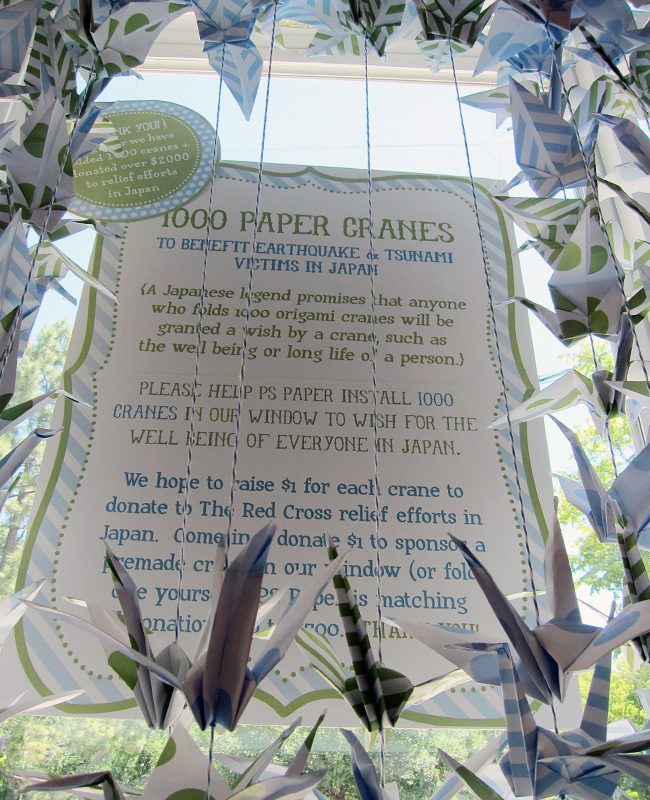
On our recent trip to California, Lindsy and I had the pleasure of stopping by PS Paper – an adorable paper boutique in San Anselmo, California. The store recently relocated, and their new location is super sweet. PS Paper specializes in custom stationery and lovely gifts – they have an incredible selection of pretty paper goods.


While visiting PS Paper, we had the chance to meet with Johanna and her friendly dog Nyack – a loveable stray who was found (and adopted!) on a hiking trip a few years back.

We were thrilled to hear the story behind all of the beautiful paper cranes hanging in the storefront window, and Johanna was kind enough to tell us all about it – check out the video below!
[iframe http://www.youtube.com/embed/fDAKmggqReA 650 370]
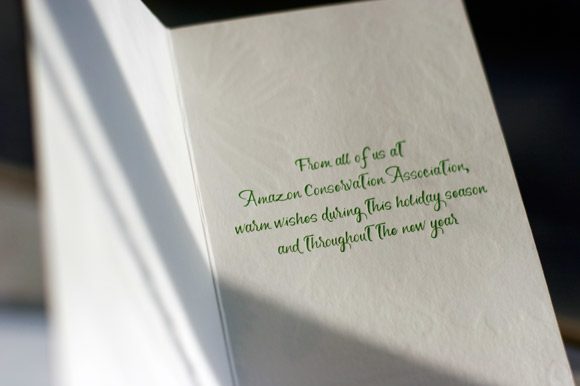
We couldn’t let the holidays completely slip away without sharing the letterpress holiday cards we printed for the Amazon Conservation Association this year. ACA is one of the eco organizations we regularly partner with on special projects and pro bono printing throughout the year and these letterpress holiday cards were an especially fun project. Letterpress printed in rich green and blue inks to match their branding, we designed them greeting card style playing on one of the pretty floral motifs from our Everyday stationery collection. For more information about our eco commitment, read more about our environmental efforts and the organizations we support through donations via 1% For the Planet, pro bono printing and special projects.